


Introduction
The last two decades have seen cyberspace evolve from a niche network of academic and military links into a vast, global digital ecosystem driven by ubiquitous connectivity, cloud computing, mobile devices, and the Internet of Things (IoT). Advances in artificial intelligence, high‑speed networks, and cheap sensors have multiplied the volume, velocity, and variety of data, enabling new services, business models, and real‑time interactions across every sector.
This acceleration is self‑reinforcing: more users and devices spur more investment in infrastructure and platforms, which, in turn, enable ever more sophisticated applications. This rapid expansion has reshaped economies, politics and daily life, while creating complex challenges for security, privacy and governance. As cyberspace has expanded into a dense, data‑driven domain that underpins civilian life and military operations alike, defense cooperation must adapt from isolated national programs to coordinated, technology‑led responses. PESCO provides that bridge by translating the strategic challenges of ubiquitous connectivity, AI, and sensor proliferation into joint projects, shared training, and interoperable tools that strengthen collective cyber resilience and integrate cyber effects into Command, Control, Communications, Computers, Intelligence, Surveillance and Reconnaissance (C4ISR) architectures.
PESCO: Guiding EU Cyber-C4ISR Integration and Development
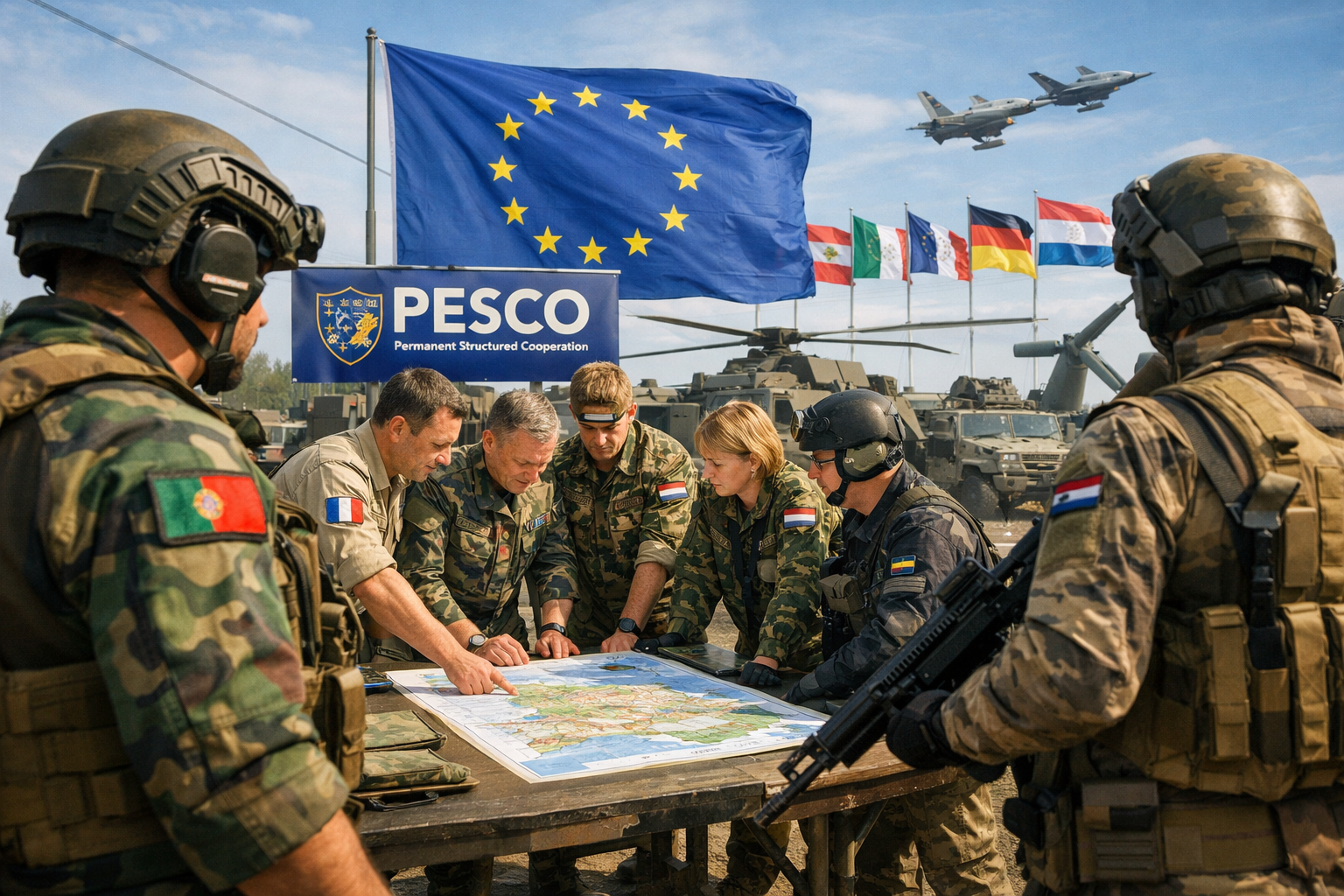
PESCO (Permanent Structured Cooperation) has become a central EU instrument for pooling defense resources and accelerating joint cyber and technology capabilities, driving projects that create multinational cyber rapid‑response teams, interconnected training infrastructures, and an EU cyber academy—initiatives in which Portugal is an active participant.
By enabling Member States to pool resources and coordinate capability development, PESCO hosts dedicated cyber projects that translate policy into operational tools and shared services. Initiatives such as the Cyber Rapid Response Teams and Mutual Assistance in Cyber Security (CRRT) assemble deployable multinational teams and a common cyber toolkit to assist Member States, EU institutions, CSDP missions and partner countries, working in complementarity with CERT‑EU and ENISA to improve interoperability and collective incident response. Portugal’s participation in PESCO cyber arrangements—illustrated by national decisions to join project arrangements such as the Cyber Threats and Incident Response Information Sharing Platform (CTISP)—reflect how PESCO’s structure, materializes concrete national commitments, by building shared incident-response infrastructure and threat-information exchange.
Beyond immediate incident response, PESCO fosters technology, training, and innovation ecosystems that accelerate capability maturation across the EU. Projects such as the EU Cyber Academia and Innovation Hub (EU‑CAIH) aim to build centers of excellence for cybersecurity education, research and industry collaboration, addressing skills gaps and promoting joint R&D and curricula; the Cyber Ranges Federation (CRF) connects national cyber training platforms so Member States can run realistic, multinational exercises, test new technologies, and co‑develop tools for defense and resilience. These initiatives, together with broader analyses of the evolving cyber landscape, reflect a strategic shift from fragmented national programs toward multinational, interoperable cyber capabilities, shared toolkits, and joint training infrastructures designed to speed technological innovation and strengthen the EU’s collective capacity to deter and manage cyber threats.
On the other hand, PESCO’s Electromagnetic Warfare Capability and Interoperability Programme for Future Joint Intelligence, Surveillance and Reconnaissance Cooperation drives concrete steps to integrate EW into broader C4ISR architectures by conducting a comprehensive feasibility study of national EW capabilities, identifying capability gaps, and proposing joint concepts of operation (CONOPS) and interoperability measures that can be adopted across participating Member States. These outputs are intended to align national sensor networks, data links, and EW systems so that shared situational awareness, coordinated electronic attack and defense, and joint targeting cycles become feasible in multinational operations, while intertwined testbeds and exercises under PESCO provide the practical environment to validate concepts and mature new technologies.
Conclusion
PESCO’s project‑based approach contributes to translating the rapid expansion of cyberspace into coordinated, multinational defense capabilities by fostering shared incident‑response tools, interoperable training environments, and joint R&D that link cyber, C4ISR and electromagnetic warfare efforts. By aligning national investments, developing common CONOPS, and providing shared testbeds and education hubs, PESCO reduces fragmentation, accelerates technology maturation, and strengthens collective resilience—while also surfacing legal, technical and resource challenges that require sustained political commitment and coordinated implementation to ensure these capabilities deliver operational impact.
Lisbon, 14th of January 2026
Eduardo José da Costa Pinto Silva Esteves
EuroDefense-Jovem Portugal
References
World Economic Forum. (2025). Global Cybersecurity Outlook 2025. https://reports.weforum.org/docs/WEF_Global_Cybersecurity_Outlook_2025.pdf
Council of the European Union. (2025, May 27). Permanent Structured Cooperation (PESCO). https://www.consilium.europa.eu/en/policies/pesco/
Diário da República / Governo de Portugal. (2023, December 21). Despacho n.º 13082/2023. https://diariodarepublica.pt/dr/detalhe/despacho/13082-2023-808199531
ENISA. (n.d.). Cooperation and coordination on EU incident response and cyber crisis management. https://www.enisa.europa.eu/
PESCO. (n.d.-a). Cyber Rapid Response Teams and Mutual Assistance in Cyber Security (CRRT). https://pesco.europa.eu/project/cyber-rapid-response-teams-and-mutual-assistance-in-cyber-security/
PESCO. (n.d.-b). Cyber Ranges Federation (CRF). https://pesco.europa.eu/project/cyber-ranges-federation/
PESCO. (n.d.-c). EU Cyber Academia and Innovation Hub (EU‑CAIH). https://pesco.europa.eu/project/eu-cyber-academia-and-innovation-hub/
PESCO. (n.d.-d). Cyber Threats and Incident Response Information Sharing Platform (CTISP). https://pesco.europa.eu/project/cyber-threats-and-incident-response-information-sharing-platform/
PESCO. (n.d.-e). Electromagnetic Warfare Capability and Interoperability Programme for Future JISR Cooperation. Permanent Structured Cooperation (PESCO). https://www.pesco.europa.eu/project/electromagnetic-warfare-capability-and-interoperability-programme-for-future-joint-intelligence-surveillance-and-reconnaissance-jisr-cooperation/